


Make your chessboard a special gift
Add a personal engraving or gift wrapping with one click. You can remove these extras anytime in the cart.


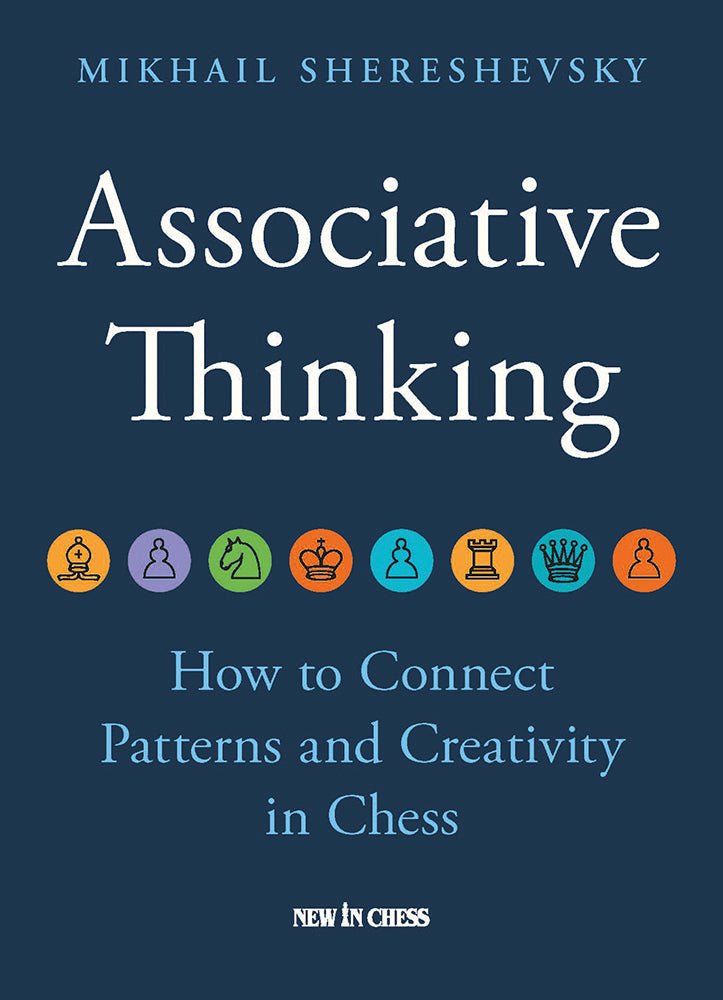

Associative Thinking (Paperback)

Add a gift box, an engraving — or both — to make it truly special.

Buy It With
€9,00
€10,00

Buy It With
€18,00
Associative Thinking by Mikhail Shereshevsky is an English-language paperback chess book that explores a practical but often overlooked route to improvement: building clear associations instead of memorising variations by rote.
What this book covers
Mikhail Shereshevsky looks at how a modern chess player can cope with too much information at the board. Rather than piling up long lines to memorise, he encourages a way of studying based on curiosity, positional images and recurring patterns. That approach helps you remember not only specific piece placements, but also the broader ideas behind them.
The book returns to the kinds of questions that come up again and again in training and play: how a knight and pawn work together, where to place a rook behind a passed pawn, or which squares matter in bishop-versus-knight endings. Shereshevsky shows that strong players have already worked out many of these ideas over time — the key is learning to recognise them and connect them at the right moment.
How the author teaches chess understanding
A major strength of the book is its use of games by leading players. Shereshevsky shows how studying classic and modern games can sharpen associative thinking, especially when the games are accompanied by the players’ own comments. Among the names featured are Ulf Andersson, Anatolij Karpow, Władimir Kramnik and Magnus Carlsen.
This is a practical training book rather than a purely theoretical one. It is designed to help readers understand typical chess mechanisms more clearly and carry those ideas into their own games. For ambitious players, it can be a useful addition to work on strategy, technique and overall study habits.
About the author and edition
Mikhail Shereshevsky wrote The Shereshevsky Method to Improve in Chess in 2018, and his best-known work, Endgame Strategy, is widely regarded as one of the key books on endgames.
If you are looking for a chess book that moves you from memorising lines towards a deeper understanding of positions, Associative Thinking is a strong choice for regular study and game analysis.
Key details
- Product type: paperback chess book
- Author: Mikhail Shereshevsky
- Language: English
- Pages: 304
- Subject: associative thinking in chess
- Content focus: practical training, positional understanding and pattern recognition
- Game material: examples and ideas from classic and modern games
- Binding: paperback


Tangible precision
Each move strengthens curiosity, concentration, and self-confidence.