


Make your chessboard a special gift
Add a personal engraving or gift wrapping with one click. You can remove these extras anytime in the cart.


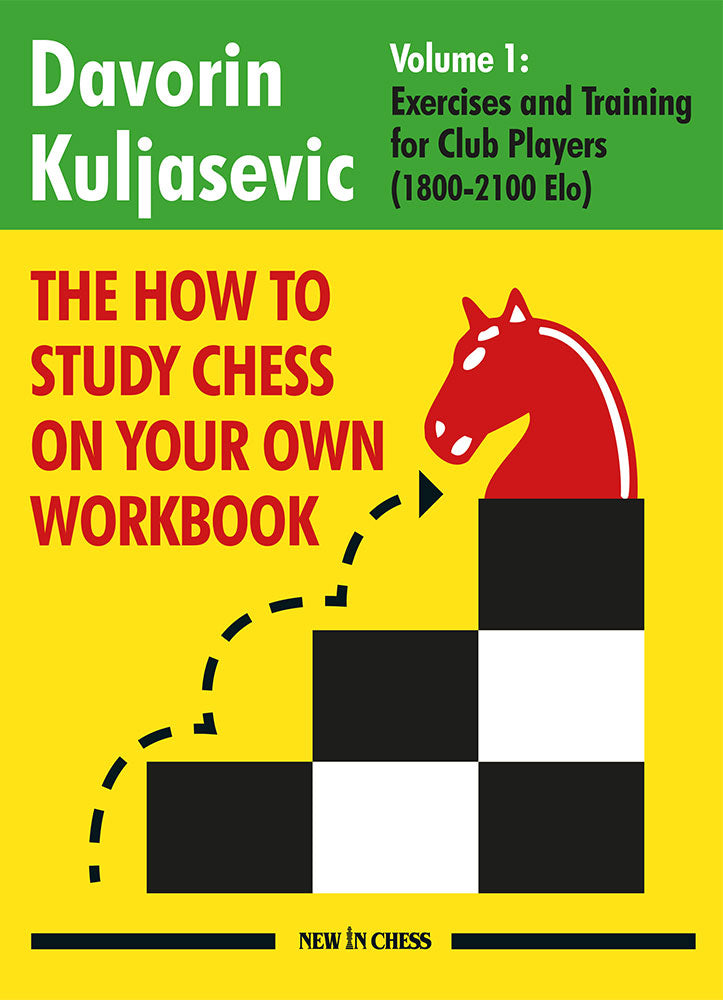

The how to study chess on your own workbook Vol1

Add a gift box, an engraving — or both — to make it truly special.

Buy It With
€9,00
€10,00

Buy It With
€18,00
The How to Study Chess on Your Own Workbook, Volume 1 is an English-language chess workbook designed for structured self-study, with guided exercises that help you move from theory into practical training.
Rather than relying on puzzles alone, this workbook takes a trainer’s approach to improvement. It offers a broader programme of work, with tasks that develop tactical awareness, positional understanding, planning and the analysis of middlegame structures.
What’s inside
You can work through the material on your own, or use parts of it with a training partner or a chess engine. The exercises include:
- positional tasks,
- find-the-best-move exercises and short planning exercises,
- work on typical middlegame structures against a partner or an engine set to the right level,
- model-game study and reconstruction exercises,
- selected position analysis with an emphasis on opening ideas and middlegame play.
This structure makes the book a useful choice for players who want a clear training plan and varied work, rather than a random collection of diagrams.
Who it’s for
Volume 1 is aimed primarily at players rated Elo 1800–2100, but it will also suit a wider range of chess players around Elo 1600–2300. It is a strong fit for ambitious club players who want to organise their study and develop positional and strategic thinking.
Edition details
- Author: Davorin Kuljasevic
- Language: English
- Binding: paperback
- Page count: 220 pages
- Volume: 1
Davorin Kuljasevic is also the author of Beyond Material: Ignore the Face Value of Your Pieces, which was a finalist for the Boleslavsky-Averbakh Award from FIDE.
Key details
- Product type: chess workbook
- Model: Volume 1
- Author: Davorin Kuljasevic
- Language: English
- Binding: paperback
- Page count: 220 pages
- Target level: Elo 1800–2100
- Additional suitable range: Elo 1600–2300


Tangible precision
Each move strengthens curiosity, concentration, and self-confidence.