


Make your chessboard a special gift
Add a personal engraving or gift wrapping with one click. You can remove these extras anytime in the cart.


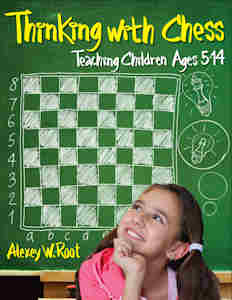

Thinking With Chess: Teaching Children Ages 5-14

Add a gift box, an engraving — or both — to make it truly special.

Buy It With
€9,00
€10,00

Buy It With
€18,00
This Thinking With Chess: Teaching Children Ages 5-14 is a practical chess education book for teachers, librarians, after-school instructors, chess coaches and parents working with children aged 5 to 14. It is written for readers who may not already know the game well, and it keeps the instruction clear and usable.
Teaching chess in a way children can follow
The book shows how to teach chess to groups of children in a structured, engaging way. Dr Alexey W. Root connects chess instruction with skills that matter in education, including classification, pattern recognition, decoding, creating and predicting. That makes the book useful not only for learning the rules, but also as a tool for supporting thinking and intellectual work.
Inside, you will find lesson plans that can be used by both first-time instructors and experienced players teaching children. It is a strong fit for school lessons, library sessions, after-school activities, chess coaching and home learning.
What the book covers
Thinking With Chess introduces the basics of the game, including piece movement, notation and places where children can play and practise. It also goes beyond the fundamentals with useful tactical motifs and training tools such as double check and smothered mate.
The book also includes exercises and puzzles that develop different ways of thinking. Some activities support divergent thinking, while others are aimed at convergent thinking. As a result, it can be used both for teaching chess and for building logic and concentration.
About the author
Dr Alexey W. Root is the author of the book. Thinking With Chess: Teaching Children Ages 5-14 was published by Mongoose Press.
Key details
- Product type: chess education book
- Author: Dr Alexey W. Root
- Publisher: Mongoose Press
- Audience: children aged 5 to 14
- Teaching focus: group chess instruction
- Educational focus: classification, pattern recognition, decoding, creating and predicting
- Chess topics covered: piece movement, notation, tactical motifs and basic training exercises
- Tactical motifs: double check and smothered mate


Tangible precision
Each move strengthens curiosity, concentration, and self-confidence.